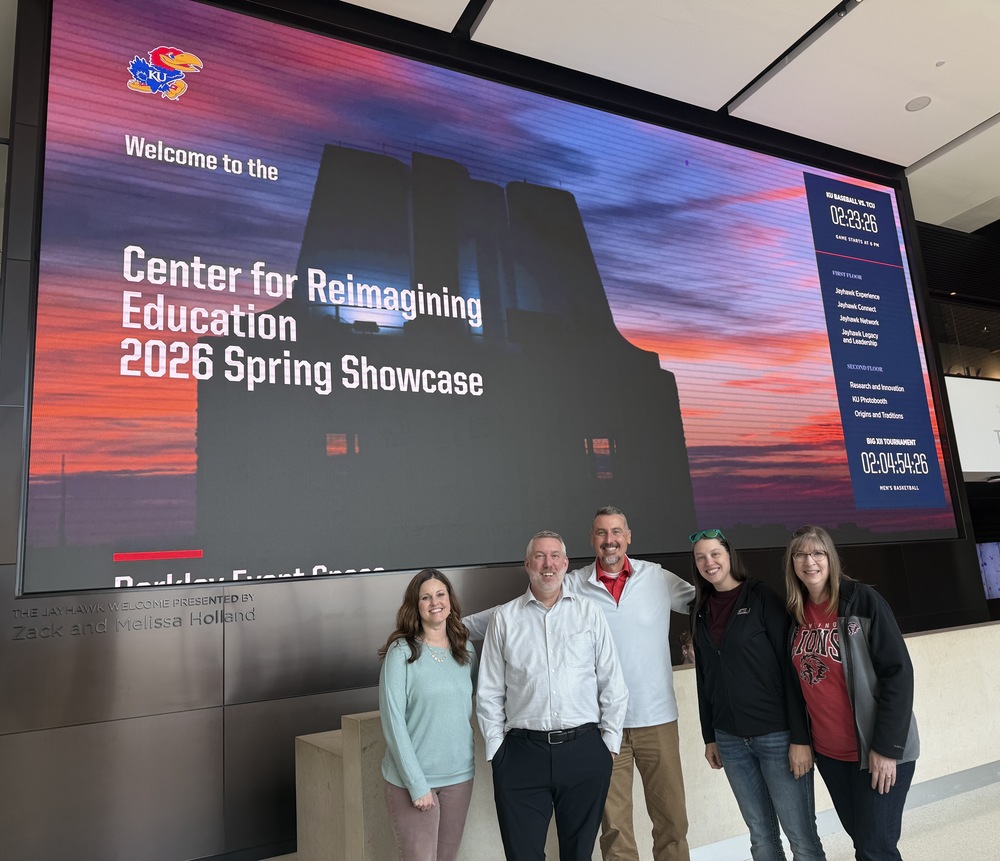
Lansing educators recently had the opportunity to share how they are reimagining teaching and learning through the Center for Reimagining Education (CRE) initiative during the 2026 Spring Showcase held March 10, 2026 at the University of Kansas.
The event brought together participating districts from across Kansas to share their progress and ideas for how artificial intelligence (AI) can support teaching and learning. In addition to Lansing, participating districts included Bonner Springs, Piper, Jeff West, Augusta, Circle, Oskaloosa, Buhler, and Jefferson North.
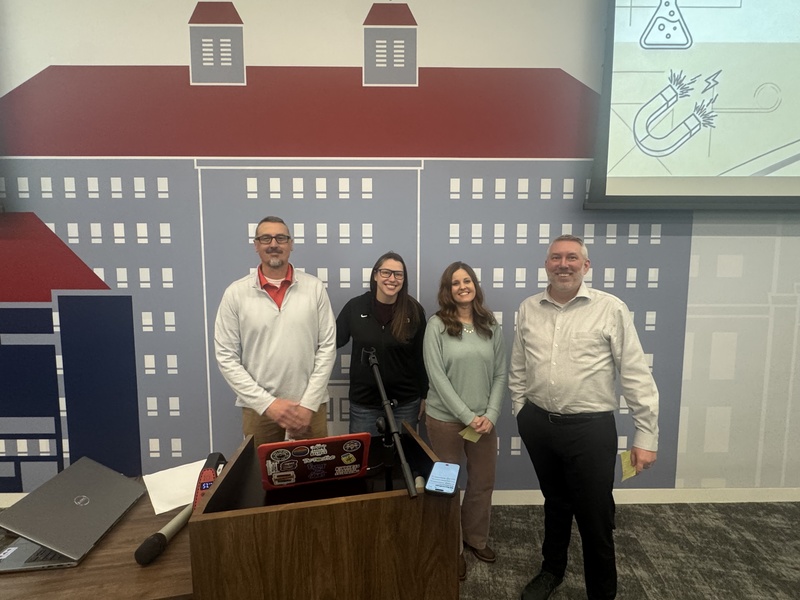
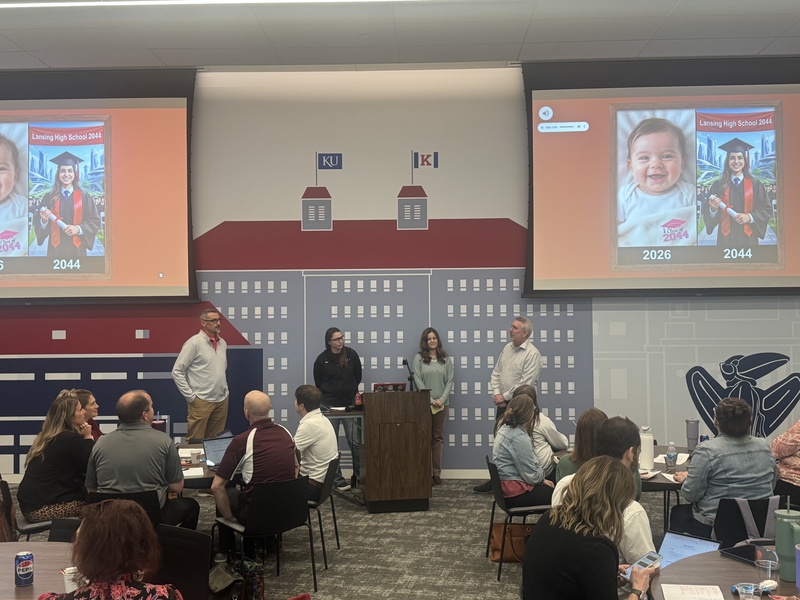
Representing Lansing were Lansing Middle School Principal Brooks Jenkins and sixth grade teachers Alisha Holyfield, Amanda Reed, and Josh Yoakam. The team presented how their work with artificial intelligence has evolved over the past two years and how it is helping students take a more active role in their learning.
The CRE initiative, supported by the Cinelli Family Foundation and the University of Kansas Center for Reimagining Education, encourages schools to explore how innovative tools like AI can enhance instruction and prepare students for an uncertain and rapidly changing future.
“We started by thinking about the long game,” Jenkins shared during the presentation. “Not one person in this room can, with a great degree of certainty, predict what the future holds for graduates in the class of 2044. That should equally terrify and excite.”
Starting Small to Grow Big
The Lansing team began their work during the first year of the initiative by focusing on a single sixth grade physical science class.
Teachers used a pre-assessment to determine what students already understood before organizing learning opportunities based on student readiness and engagement.
Mr. Yoakam explained that giving students choice was an important part of the process.
“I think that’s true in any educational setting,” he said. “The more choice that you give a student, the more engaged they’re going to be in the activity.”
Students who demonstrated mastery were able to pursue independent projects centered around chemical interactions, while other groups used teacher-created activities and AI-supported tools to deepen their understanding of the content.
Empowering Student Voice and Creativity
During the second year of the initiative, the Lansing team focused on expanding their work so it could reach all sixth grade science students rather than just one class period.
Teachers began incorporating more opportunities for student inquiry and creation, allowing students to ask their own questions and guide their learning.
Ms. Holyfield emphasized the importance of giving students ownership in the learning process.
“It gives them time to engage and reflect on the types of activities they’re doing,” she said. “It puts them more in charge of their own learning and shows them that their voice matters in education.”
Students explored topics like electromagnetic waves by using chatbots to investigate their own questions. They also created collaborative projects, such as video vocabulary presentations, where they connected scientific concepts to real-world examples in creative ways.
Supporting Teachers Along the Way
A major focus of the initiative has also been supporting teachers as they learn how to use new tools.
The Lansing team hosted professional learning sessions and invited staff to participate in training on MagicSchool AI tools during a “Build Your Own Professional Development” day. Twenty-two staff members attended the session to explore ways AI could support instruction, lesson planning, and student engagement.
Mr. Yoakam noted that helping teachers feel comfortable with the tools is an essential first step.
“If we can reduce barriers for teachers first, then we have the chance to move to what we’re doing with students - creation, inquiry, and deeper learning,” he said.
Developing Clear Guidelines for Responsible AI Use
As the district explores new opportunities with artificial intelligence, Lansing USD 469 is also taking steps to ensure these tools are used responsibly.
A draft AI policy was recently developed through the district’s District Leadership Team and discussed during the most recent Board of Education meeting. The policy will help guide responsible and ethical use of AI by both staff and students as the district continues to explore its potential in the classroom.
Looking Ahead
While Lansing has already seen promising results, educators emphasized that the work is still in its early stages.
“This is still the beginning of our journey,” Holyfield said. “This is only year two.”
Through collaboration with neighboring districts and the University of Kansas Center for Reimagining Education, Lansing educators are continuing to explore how thoughtful use of technology can enhance learning and better prepare students for the future.