
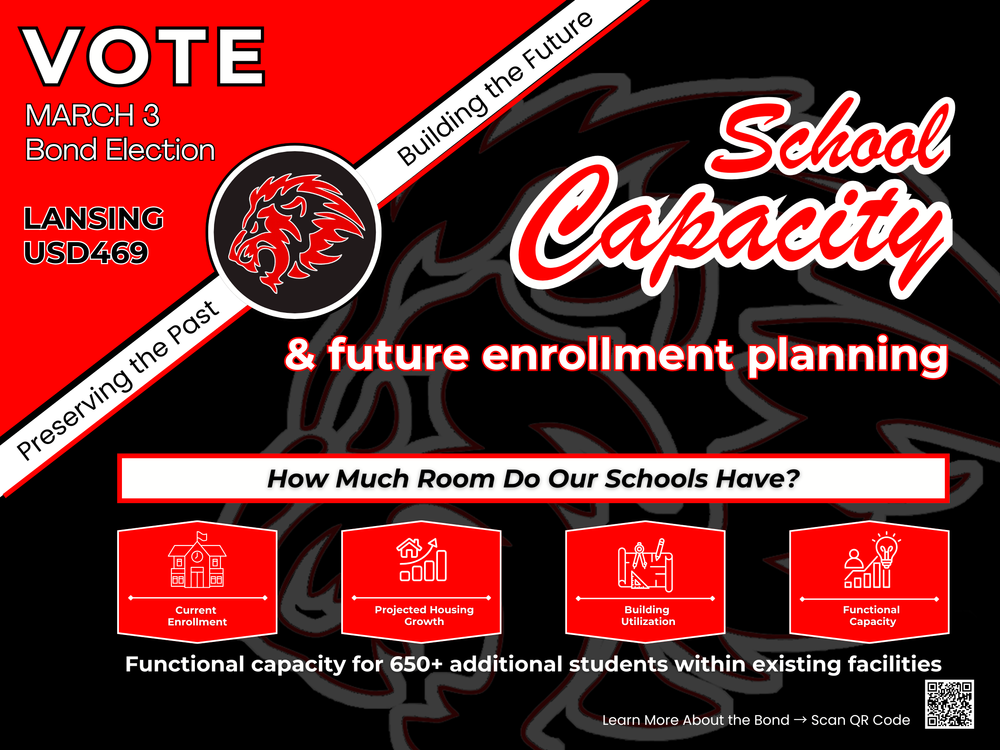
HOW MUCH ROOM DO OUR SCHOOLS HAVE?
As part of long-term planning, Lansing USD469 had a demographic and capacity study (RSP Study) done to evaluate:
Current enrollment
Projected housing growth
Building utilization
Functional
capacity
within existing facilities
The study examined not just square footage, but how instructional spaces are currently used and how they could be used in the future.
In addition to enrollment projections, the study analyzed:
Geographic distribution of students
Housing types (single-family, multifamily, etc.)
Development trends within the community
This allows the district to plan based on data rather than assumptions. Click here to view the full results of the RSP study.
WHAT IS FUNCTIONAL CAPACITY?
Functional capacity measures how many students a building can effectively serve based on:
Classroom availability
Program needs
Specialized instructional spaces
Scheduling and grade configuration
Based on the study, the district has functional capacity for approximately 650 additional students within existing facilities while maintaining current enrollment patterns.
If needed, and depending on out-of-district enrollment decisions, capacitycould increase to approximately 1,000 additional students.
The district operates most efficiently within an enrollment range of approximately 2,400–2,600 students, allowing for stable staffing, class sizes, and programming.
HOW DOES THAT RELATE TO HOUSING DEVELOPMENT?
The demographic analysis estimates that Lansing schools average approximately 0.48 students per housing unit.
To generate an increase of 650 students, approximately 1,200–1,400 new housing units would need to be added.
The study also models housing by type and location, helping the district understand how specific developments may impact enrollment.
WHAT ABOUT OUT-OF-DISTRICT STUDENTS?
The district currently enrolls approximately 450 out-of-district students.
Out-of-district enrollment helps stabilize enrollment levels and maintain consistent programming.
If future enrollment patterns required adjustment, the district could modify out-of-district attendance to help manage building capacity.
WHERE IS THERE ROOM TO GROW?
According to the capacity study:
The high school has significant room for growth
The middle school has available
capacity
Elementary buildings have flexibility in grade configuration
Potential adjustments, if enrollment patterns change in the future, could include:
Shifting grade levels between buildings
Utilizing existing spaces differently
Reconfiguring programs within current facilities
WILL ANOTHER BOND BE NEEDED SOON IF ENROLLMENT INCREASES?
Based on the demographic study and current projections, the district can accommodate projected growth within existing facilities for the foreseeable future.
The current bond proposal does not include building new schools. It focuses on maintaining and improving existing facilities.
Learn More
Early Voting In Person - Lansing Fire Station: February 28, 8 AM - 12 PM
General Election: March 3