
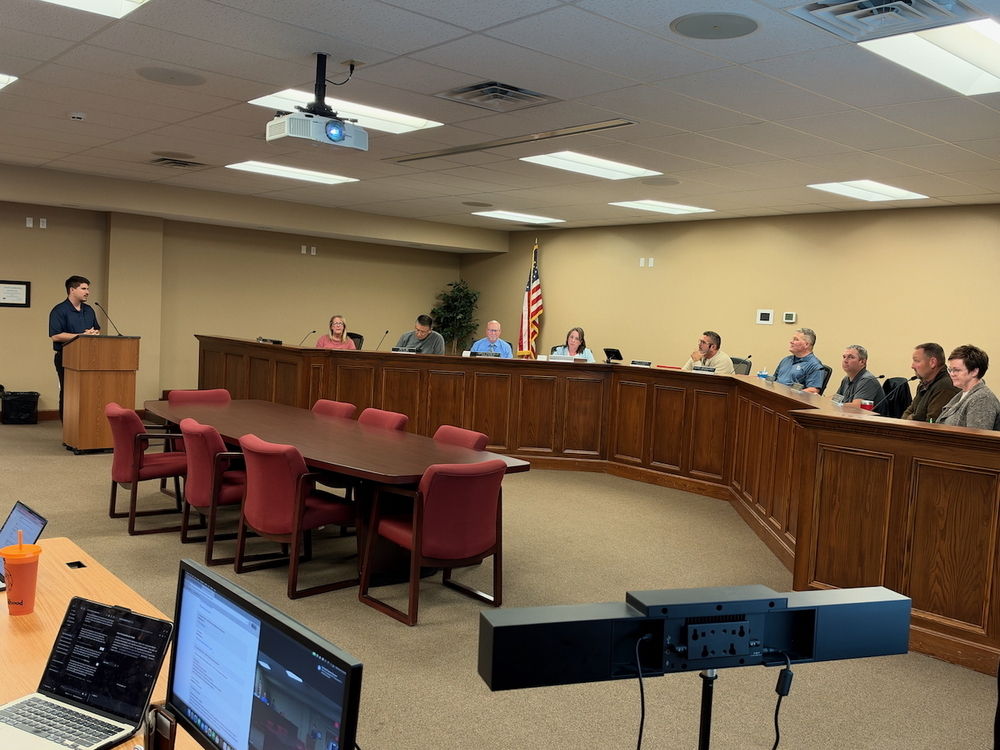
At the November 9 Lansing USD 469 Board of Education meeting, Lansing Middle School choir director Josiah Ketterman shared a student achievement presentation highlighting the important role music and fine arts education play in student learning, academic success, and personal development.
Mr. Ketterman, who also serves as the school's Exploratory Department Chair and a member of the Building Leadership Team, presented Why the Arts Matter in Public Education: The Fine Arts Impact on Core Academic Areas. His presentation explored how skills developed in music classrooms extend well beyond musical performance.
Music Education Connects to Core Academic Subjects
Mr. Ketterman explained that music education naturally incorporates concepts students encounter in other academic subjects, including mathematics, foreign language, and physical science.
When students read music, they interpret complex symbols, recognize patterns, and learn terminology rooted in Italian. Understanding rhythm requires mathematical skills such as fractions, ratios, and division, while producing and controlling sound involves concepts related to acoustics, sound waves, and physical science.
He also highlighted connections between music and mathematical reasoning, explaining how recognizing musical patterns, understanding chord structures, and interpreting rhythms reinforce skills used in algebra and geometry.
Building Skills Beyond the Classroom
In addition to academic connections, Mr. Ketterman emphasized the behavioral and interpersonal skills students develop through music.
Preparing for a concert often requires months of practice, concentration, and dedication. Students must learn to recognize mistakes, make adjustments, and continue working through challenges.
Ensemble performances also require collaboration. Whether performing in a choir, band, or orchestra, students must listen to one another, adjust their timing and volume, and work together toward a common goal.
Mr. Ketterman noted that these experiences help students develop perseverance, critical thinking, problem-solving skills, and the ability to work successfully with others.
The Connection Between Fine Arts and Student Achievement
Mr. Ketterman also shared research examining the relationship between participation in fine arts and academic performance.
His presentation highlighted studies showing that students who participate in fine arts programs for multiple years tend to demonstrate stronger performance on standardized assessments, including the SAT, ACT, and Kansas state assessments.
One example from his presentation showed an average ACT composite score of 23.4 among students with four or more years of arts education, compared to 20.3 among students with zero to one year of participation.
Beyond academic performance, Mr. Ketterman discussed the importance of music education in helping students feel connected to their schools. He shared research from the National Endowment for the Arts examining the relationship between arts participation, school engagement, and graduation outcomes, particularly among students from lower socioeconomic backgrounds.
He emphasized that being part of an ensemble gives students an opportunity to contribute to something larger than themselves while building meaningful connections with their peers.
Continued Support for Fine Arts Education
Following the presentation, Board members thanked Mr. Ketterman for his work and discussed the importance of continued investment in fine arts opportunities.
When asked what could help take the district's music programs to the next level, Mr. Ketterman expressed appreciation for the resources already available while acknowledging the ongoing costs associated with maintaining quality fine arts programs.
He highlighted support from the Lansing Educational Foundation, including grants that have helped provide equipment for district productions, and discussed additional needs involving auditorium sound equipment and acoustics.
Board members also recognized the connections between music and other academic disciplines, emphasizing the value of incorporating the arts into a well-rounded education.
Mr. Ketterman closed his presentation by thanking the Board and district for their continued support of public music and arts education.
His central message was that music education is not simply an extracurricular opportunity, but an important part of helping students grow academically, socially, and personally.
As Ketterman summarized in his presentation, "Music Education is Core Academic Infrastructure."