
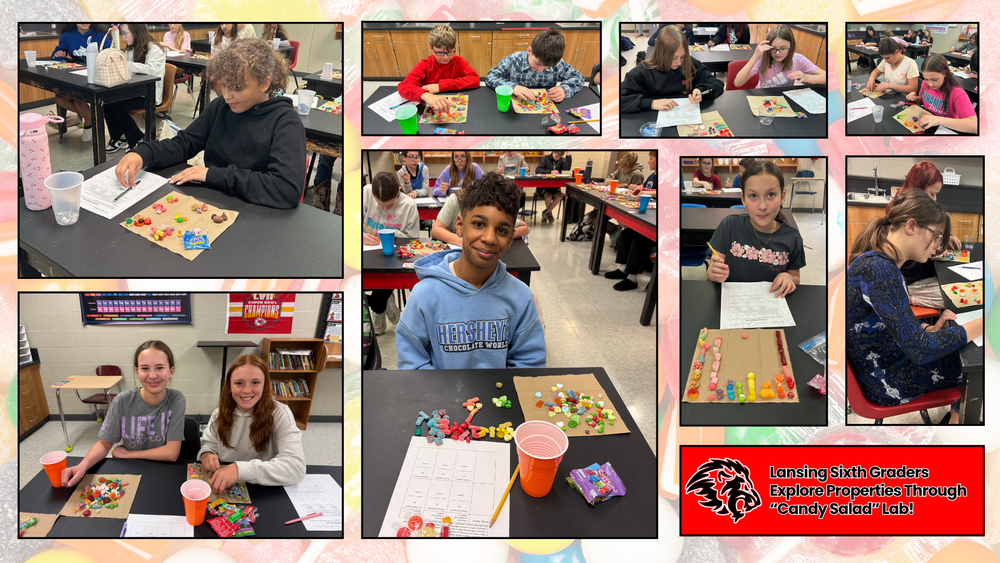
Sixth grade students in Ms. Amanda Reed’s and Ms. Alisha Holyfield’s science classes recently brought their learning to life through a hands-on “Candy Salad” lab.
As part of their study of matter, students were introduced to the difference between physical properties (what can be observed) and chemical properties, which describe how a substance can change into something new. With this foundation in place, students applied their understanding by sorting a variety of candies based on observable traits such as color, size, shape, and texture.
Through the activity, students also explored the difference between a substance and a mixture, discovering that even when items are combined, each piece retains its original properties and can be separated again.
Students were quick to share what made the lab both fun and meaningful.
“Eating the candy,” said Jonah Barnes when asked about his favorite part.
“What surprised me the most was that the variety of candy to sort was so wide. I really liked doing the sort and I appreciate this,” shared Luke Angello.
“I learned how to identify different physical properties,” added Delaney Collins.
“It’s easy to sort things in groups. I sorted my candy by size (big and small) and taste (sour and sweet),” explained Elaine Dalton.
“There are a lot of different ways to classify stuff,” said Abigail Mains.
“It was fun to sort out and learn or think about candy in different ways,” shared Brock Garrett.
Students also demonstrated their understanding of key concepts during the lab.
“Sort it by its texture, hardness, or size,” explained Tucker Brownlee and Channing Dessert when describing how to sort by physical properties.
“Yes, because some of them didn’t have definite shapes or colors,” added Olivia Wit when asked if any candy was tricky to sort.
Ms. Reed noted that the activity provided valuable insight into student thinking and creativity.
“I had a lot of fun watching students interact and compare the physical properties they were looking at,” she said. “It really helped students see that when you mix candies together, it does not change what they are, and they can be sorted back into their original properties.”
She also highlighted a standout moment of creativity from one student who went beyond the assignment by organizing candies by color and placing multi-colored items, like gummy worms, in the middle to connect categories.
“I thought that was extremely creative,” Ms. Reed shared. “And hearing students say ‘thank you’ and talk about how much fun they were having makes the chaos of labs worthwhile.”
This engaging lesson not only reinforced key scientific concepts, but also gave students the opportunity to practice observation, teamwork, and scientific thinking in a memorable way.