
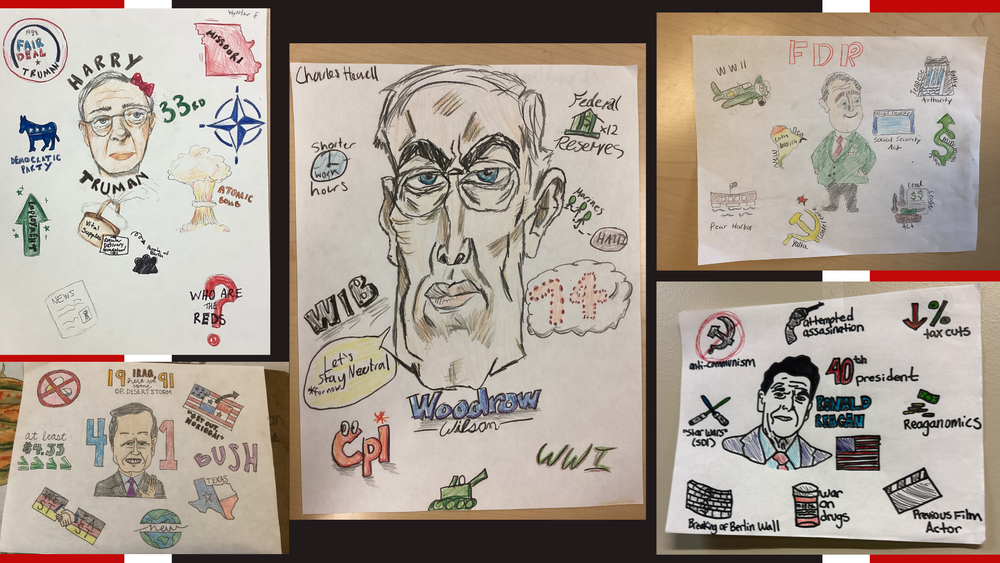
There are incredible lessons, projects, and opportunities for students throughout Lansing High School. To share these initiatives, Dr. Penrose sends an all-staff email with pictures of an assignment, project, or activity and titles it “Name It, Claim It.” The teacher responsible then replies to all staff to briefly explain what the unit is, what they are doing, and any reactions. The email allows teachers to visit other teachers’ classrooms virtually and start conversations about student learning, cross-curricular activities, and differentiation.
The December 3rd “Name It, Claim It” features Social Studies teacher Michael Basler and his American Government students, who were captured in the middle of an interactive Gallery Walk.
“This is the American Government classes participating in a ‘Gallery Walk,’” Basler shared.
Gallery walks are not new to the Social Studies department, but this year they are being used with renewed intention across multiple courses. Basler explained that a key focus for the Social Studies PLC in 2025–26 is to strengthen shared instructional practices that students will experience repeatedly as they move through the program.
“One of the 2025–26 initiatives for the social studies PLC department was to establish some shared lessons that we could use from course to course,” he said. “One of those was the use of gallery walks for students to view items like WWI & WWII propaganda, posters from civil rights era, political campaign posters/pamphlets & sketch notes. This would give students some common practice in viewing and evaluating materials & pictures as they progress from World History, American History, American Government & our social studies electives.”
Research, Sketch Notes, and Student Choice
Basler noted that this specific Gallery Walk took place during the Foreign and Domestic Policy Unit in American Government. Students were given the chance to follow their curiosity, selecting a president they were genuinely interested in studying.
“This particular lesson was from our government Foreign and Domestic Policy Unit,” he explained. “We asked students to pick a particular president from the 20th or 21st century that they were interested in learning about.”
From there, students moved into a two-part research and creation process. First, they developed a presidential biography emphasizing both foreign and domestic policy decisions. Then, they transformed that research into visual sketch notes designed to communicate meaning quickly and clearly.
“Students had to research & produce a presidential bio which included information on both Foreign & Domestic policies that were initiated during the presidential term,” Basler said. “The second part of the lesson students were asked to take their presidential bio & created/develop sketch notes of their president.”
The final products were shared publicly in the classroom for peer review and discussion, turning student work into a learning tool for everyone.
“The sketch notes were collected & publish for viewing,” he continued. “Students were required to have a picture or cartoon of the president and images or symbols from the various policies president’s initiated during their term(s).”
Learning From One Another
Once the gallery was up, students circulated through their classmates’ work, evaluating how effectively each sketch-note set communicated its message. Basler emphasized that this stage helps students sharpen both content understanding and visual literacy skills.
“Students then viewed their classmates’ sketch notes to see how effective the sketch notes were in translating a message about the foreign and domestic policies,” he said.
To close the experience, students reflected in writing, choosing the examples they found most successful and explaining why.
“Finally, students were asked to summarize in a short paragraph which sketch notes version they liked the best & explain why,” Basler shared.
A Strategy Students Enjoy, and Teachers Keep Improving
Basler said Gallery Walks have been a consistent success in Social Studies classrooms, because they invite movement, discussion, and active engagement with content.
“Over the years our department has used gallery walks, it’s been a very productive lesson for our classes, and the students have enjoyed the opportunity to do them,” he noted.
He also invited staff to continue the professional conversation by offering ideas for future growth.
Basler closed his message with gratitude for the chance to highlight student learning in Government: “Appreciate the opportunity to share what goes on in Government.”